
BACKGROUND
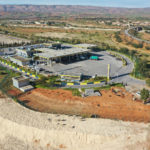
This project is the installation of a watertight System O)) at a center
for up to 250 children and adolescents who live on the streets or who are in high risk situations and require rehabilitation. The system was designed to
passively treat and recover the wastewater. The treated wastewater is
recovered and held in a holding tank to be used to irrigate green
spaces. With no moving parts or filter media to replace or break, the
watertight System O )) was the most cost-effective, long-lasting and
efficient option.
PRIMARY TREATMENT
The System O)) is preceded by a primary treatment. Raw wastewater
leaving the center is collected in a septic tank with an effective volume
of 18,000 L. Inside the septic tank, the wastewater separates into layers
as the fats float to the top and the solids sink to the bottom of the tank.
DISTRIBUTION
The effluent of the septic tank flows by gravity into a main distribution
box that evenly distributes effluent to four other distribution boxes. Each
of these four distribution boxes distributes wastewater evenly into five
rows of Advanced Enviro))Septic pipes. The proper functioning
of the System O)) depends on a uniform distribution of
wastewater between the Advanced Enviro))Septic pipe rows. This is
achieved with the help of equalizers installed inside the distribution box.
These equalizers have weirs that are manually adjusted by a dial during
the installation. These are the only moveable parts in the entire system.
Once they are set during the installation, they don’t need to be adjusted
again. The treated effluent of the system is recovered and collected in a
holding tank to be reused.
ADVANCED SECONDARY TREATMENT
This waterlight System O)) uses one cell consisting of 20 rows of
Advanced Enviro))Septic (AES) pipes for a total of 100 pipes. The
wastewater flows along the length of the AES rows where it is
treated by bacteria living in the aes pipes and in the filter sand
during the infiltration process.
RECOVERY OF TREATED WATER
Underneath the System O)), there is a watertight membrane and a
network of collection pipes. All of the water that is treated by the
System O)) is recuperated by this network and directed towards
a pumping station where it is then pumped into a recovered water
holding tank. The water in this tank can then be used for
irrigation.
ECONOMIC ADVANTAGES
Previously, with the conventional system, everything was automated until
the equipment electromechanical equipment begins to fail, and the plant
has ceased to operate with the consequent problem of contamination of
water unsuitable for reuse. What’s more, the System O installation)) does
not require any maintenance and there is no filter media to change or
mechanical part that can break. Today, since the installation of our
System O)) in 2018, the client was able to save up to 80% in drinking
water and electricity.
TREATMENT RESULTS
To learn more about this installation and see by yourself, the treatment results, please download the case study using the link below.